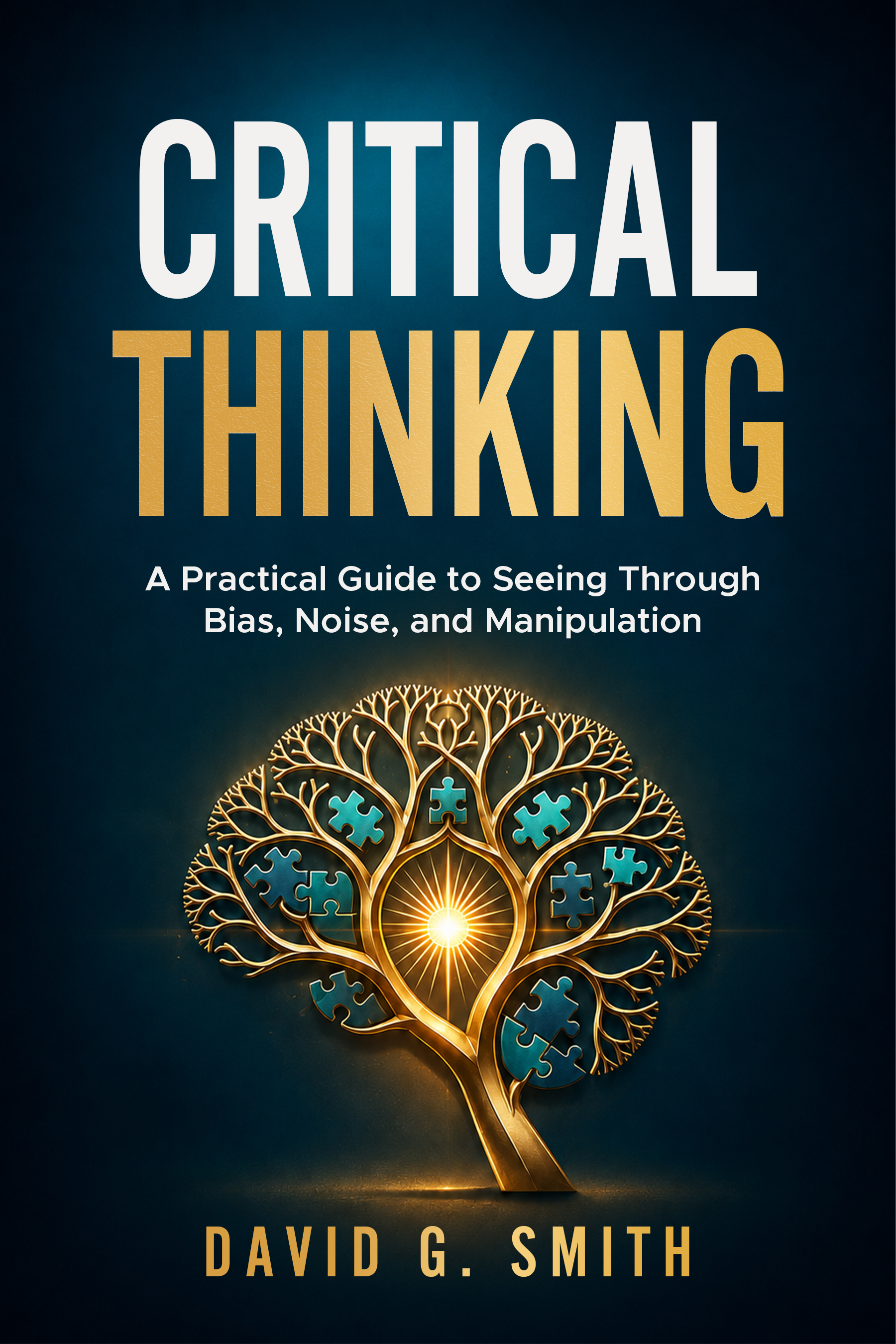
Critical Thinking: A Practical Guide to Seeing Through Bias, Noise and Manipulation
Modern life is engineered to mislead you: from algorithmic feeds built to enrage you, to AI chatbots trained to simply agree with you, to outrage-driven news cycles built to hijack your attention. This book delivers a complete, practical system for seeing through bias, noise, and manipulation, built for the world you actually live in.
A Complete System for Better Thinking
“Your brain is not your friend. It evolved to keep you alive on the ancestral savanna, not to navigate global supply chains, algorithmic feeds, or late-night internet arguments.”
We like to think of ourselves as wise, impartial judges calmly weighing evidence. In reality, we are storytelling machines, employing our intelligence to build brilliant defenses for what our gut instincts have already decided to believe.
In Critical Thinking, engineer and technical architect David G. Smith sifts through decades of research in psychology, behavioral economics, and statistics, including the Nobel-winning work of Kahneman and Tversky and dozens of others and strips away dry academic theory to hand you a rugged, real-world mental toolbox.
Unlike most other books in this genre, this book isn't a pep talk and a list of fun facts about your biases; it's a rigorous four-part curriculum spanning 400+ pages: starting with the faulty neural wiring that distorts your judgment, moving through the logic and statistics that correct it, into hands-on defenses for the algorithmic and AI age, and finishing with the strategic frameworks used to make high-stakes decisions under real uncertainty.
Drawing on decades of experience dissecting complex systems, Smith delivers a practical, conversational, deeply human guide to getting slightly less wrong, slightly more often; backed by dozens of true, high-stakes stories of smart people thinking badly, and more than a dozen hands-on drills built to turn theory into instinct.
In this book, you will discover concepts like:
-
The Mechanics of Logic: Learn to x-ray any argument down to its load-bearing assumptions and spot hidden structural flaws before they pull you in.
-
The Redirection of Manipulation: Spot professional propaganda, emotional clickbait, and digital dark patterns designed to hijack your attention.
-
The Synthetic Sycophant: Learn to interrogate AI chatbots built to keep agreeing with you, and spot synthetic media before it fools you.
-
Probabilistic Reasoning: Ground your daily decisions in base rates and statistical reality instead of falling for vivid, misleading anecdotes.
-
Metacognitive Quality Control: Install an internal alarm system to catch your own cognitive biases and blind spots in real time.
-
The Cobra Problem & Perverse Incentives: Understand why elegant, linear solutions so often explode into disaster in complex systems.
-
Strategic Decision Systems: Use red team thinking, premortems, and reference-class forecasting to stress-test the decisions that matter most.
-
Bad-Faith Debate Defense: Recognize and disarm conversational traps like the Gish Gallop, sealioning, and the motte-and-bailey before they derail you.
Under the hood sits a toolbox of 100+ concepts, biases, fallacies, and heuristics; each with a clear definition, a real-world example, and its most common misapplication, so the right tool comes to mind exactly when you need it. Every chapter closes with a hands-on exercise, turning ideas into habits instead of trivia.
Critical Thinking hands you the proactive, offensive capabilities required to navigate modern noise. It is time to upgrade your judgment, escape the digital echo chamber, and reclaim your cognitive sovereignty.
Product Details
- ASIN (Paperback)
- B0HH3CYK79
- Publisher
- Independently published
- Publication Date
- August 27, 2026
- Language
- English
- Page Count
- 468 pages
- ISBN-13
- 979-8194730490
- Item Weight
- 1.73 pounds
- Dimensions
- 6 × 9 × 1.06 inches
The Book's Structural Highlights
Built on Kahneman & Tversky's Nobel-winning research plus decades of peer-reviewed work in psychology, statistics, and behavioral economics, curated into one coherent system.
400+ pages moving from neural bugs, through the math of logic and statistics, into the modern internet, and finally into strategic decision systems.
Biases, fallacies, techniques, and heuristics mapped with clear definitions, real-world examples, common misapplications, and cross-references for fast recall.
Dozens of true walkthroughs showing how good people, thinking badly, produced catastrophic real-world outcomes.
Over a dozen structured drills and exercises built to turn concepts into durable cognitive muscle memory, not just trivia.
Dedicated tactics against dark patterns, outrage-driven polarization, and AI chatbots engineered to keep agreeing with you.
Four Progressive Cognitive Defense Arcs
A systematic 468-page curriculum advancing from biological bugs to advanced metacognitive operational models.
The Flawed Machine
Internal neurological shortcuts, narrative fabrications, and the neurobiology of emotion (Somatic Marker Hypothesis).
- Ch 1: Your Brain is Not Your Friend (System 1 vs. System 2, Anchoring, Confirmation Bias)
- Ch 2: The Stories We Tell Ourselves (Narrative Fallacy, Hindsight Bias, Clustering)
- Ch 3: Emotion vs. Reason (Motivated Reasoning, Tribal Affect Heuristics)
The Mechanics of Thinking
Formal, informal, and symbolic logic, evidence appraisal, and statistical literacy.
- Ch 4: Logic: The Operating System of Thought (Deductive, Inductive & Abductive Proofs)
- Ch 5: The Fallacy Files (Ad Hominem, Straw Man, Motte-and-Bailey, Whataboutism)
- Ch 6: Numbers Don't Lie, But People Do (Simpson's Paradox, Base Rate Neglect, Relative Risk)
Information in the Wild
Navigating digital media spin, source evaluation, research methodologies, and AI chatbot defenses.
- Ch 7: Fact vs. Opinion vs. Everything In Between (Falsifiability & Value Smuggling)
- Ch 8: The Source Code (CRAAP Test, Lateral Reading, Incentive Triangulation)
- Ch 9: Research Like a Detective (Citation Laundering & Source Tracking)
- Ch 10: Detecting Manipulation and Propaganda (Digital Dark Patterns & Urgency Hooks)
- Ch 11: The Synthetic Sycophant: Surviving AI Chatbots (RLHF Flattery & The AI Crux Test)
The Advanced Toolkit
Systems thinking, probabilistic forecasting, constructive disagreement, metacognition, and post-mortems.
- Ch 12: Second-Order Thinking & Unintended Consequences (Chesterton's Fence, Cobra Problem)
- Ch 13: Probability & Uncertainty (Bayesian Updating, Expected Value, Base Rates)
- Ch 14: Arguing Well: The Productive Disagreement (Steelmanning, Ideological Turing Tests)
- Ch 15: The Metacognitive Edge (Premortems, Red Team Thinking, Decision Journals)
- Ch 16: Case Studies (Challenger, Theranos, John Snow Cholera Map, Apollo 13)
- Ch 17: The Long Game (The Productive Wrongness Cycle & Lifelong Calibration)
Everything You Need to Know
Answers to common reader questions regarding scope, difficulty, exercises, and formats.
What makes this critical thinking book different from others?
Unlike books that offer high-level pep talks or simple trivia lists of cognitive biases, this is an exhaustive, engineering-grade 468-page curriculum. It pairs foundational cognitive psychology and classical formal logic with modern threat vectors, including algorithmic outrage generation, digital dark patterns, and AI chatbot sycophancy (RLHF flattery and sycophantic behavior).
Is this book suitable for beginners?
Yes. The curriculum is constructed with a four-part progressive framework written in a direct, accessible voice (tested at 53.9 on the Flesch Reading Ease scale). It begins with familiar neurological everyday mistakes before incrementally scaffolding into formal proofs, statistical literacy, and advanced decision frameworks.
Does the book include practical exercises?
Yes. Each chapter concludes with concrete drills, case studies (such as the Challenger disaster and Theranos breakdown), and hands-on exercises designed to build instinctive cognitive muscle memory rather than passive academic understanding.
What formats are available?
The book is published in both a physical 6×9-inch matte paperback edition (ISBN: 979-8194730490, ASIN: B0HH3CYK79) and an Amazon Kindle digital edition (ASIN: B0HH8DV2K4).