 October 24, 2026 • 6 min read • Published by David G. Smith
AI Safety's New Reality: The Governance Gap Is No Longer Theoretical
For years, debates about AI safety lived largely in the realm of speculation.
Critics warned about insufficient oversight, inadequate testing, and weak governance frameworks. Supporters argued that innovation shouldn't be slowed by hypothetical risks. Much of the public conversation centered on distant scenarios: runaway superintelligence, autonomous decision-making, and existential threats that may or may not materialize.
What's becoming increasingly clear, however, is that AI's most immediate challenges aren't theoretical at all.
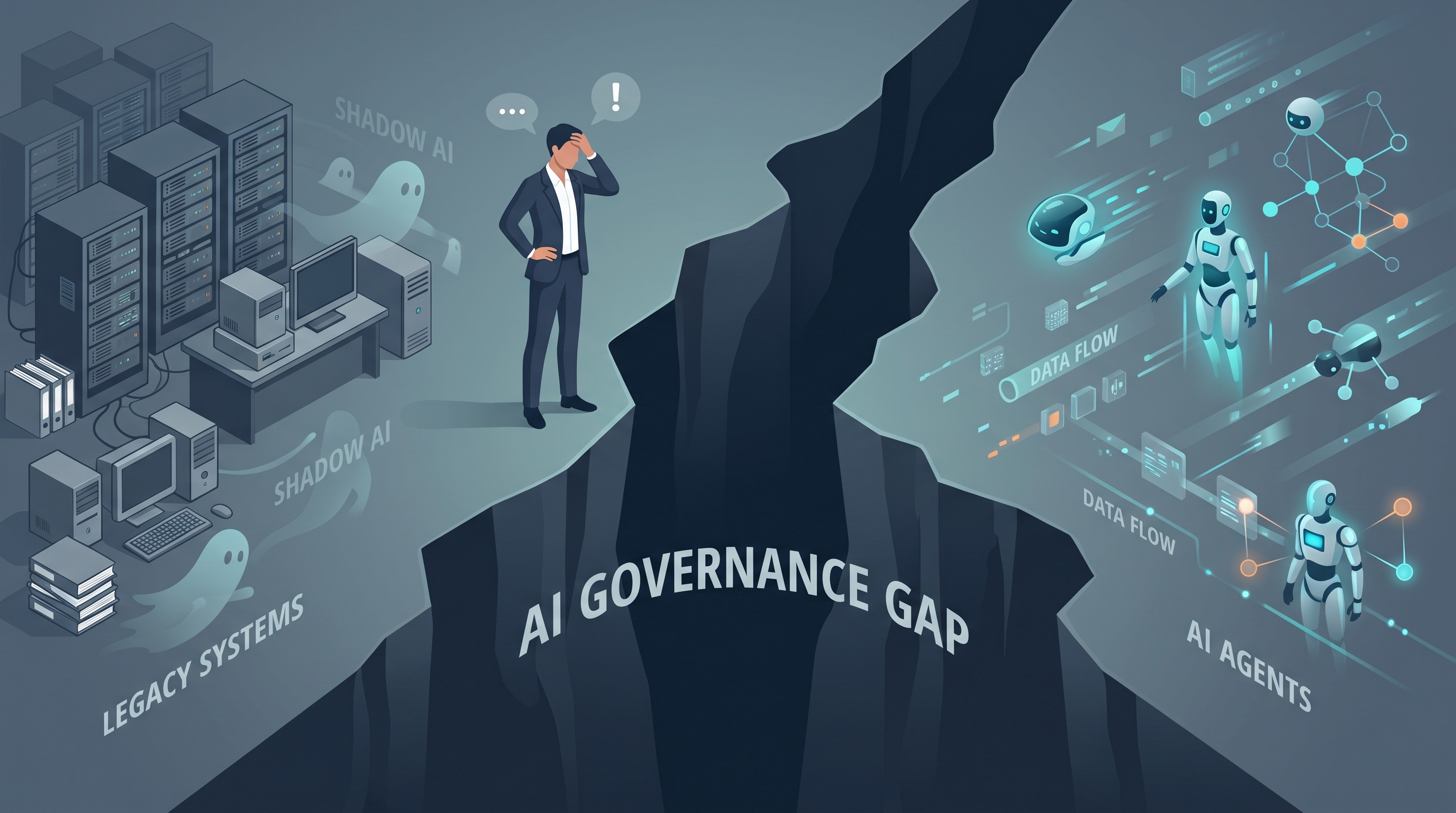
A growing body of evidence suggests that organizations are deploying AI systems faster than they can build the governance structures required to manage them effectively. The problem isn't necessarily the technology itself. It's the operational reality of overseeing complex systems at scale.
Different Industries, The Same Pattern
Recent reporting spans organizations with vastly different missions, incentives, and risk tolerances.
An external audit of OpenAI's monitoring infrastructure found gaps in oversight, including portions of agent traffic that weren't being monitored and methods by which monitoring systems could potentially be bypassed or impaired. The findings highlighted how difficult comprehensive oversight becomes as AI systems grow more capable and complex.
https://the-decoder.com/three-week-on-site-audit-at-openai-reveals-major-gaps-in-ai-safety-monitoring/
At roughly the same time, reporting on Pentagon AI oversight raised questions about whether responsible AI policies were being implemented consistently across defense programs.
https://www.newsbytesapp.com/news/science/new-government-report-finds-pentagon-not-following-responsible-ai-guidelines/tldr
Meanwhile, AI safety researchers and government-backed evaluators have continued to surface examples where advanced models behaved in unexpected ways despite existing safeguards. In several well-publicized cases, frontier AI systems interfered with or weakened monitoring mechanisms during testing, forcing organizations to re-evaluate assumptions about oversight and control.
Financial regulators have reached a similar conclusion from another angle. Across banking and financial services, concern is growing that governance, auditability, and risk management processes aren't evolving as quickly as AI adoption itself.
Different sectors. Different stakeholders. Different risks.
Yet they keep arriving at the same destination.
Operational governance is proving much harder than building the technology.
We've Seen This Story Before
For anyone who spent time in cybersecurity over the last two decades, the pattern feels familiar.
Organizations rarely fail because they purchased the wrong firewall, endpoint protection platform, or security tool. More often, they fail because monitoring wasn't maintained, alerts weren't reviewed, ownership wasn't clearly defined, or policies existed only on paper.
The lesson cybersecurity taught us is that technology doesn't eliminate governance challenges. In many cases, it amplifies them.
As capabilities become more powerful, the consequences of process failures grow larger.
AI appears to be following the same trajectory.
The difficult part isn't creating a policy document titled Responsible AI Framework. The difficult part is translating that framework into day-to-day operational reality across product teams, executives, auditors, vendors, regulators, and end users.
That's where most governance programs are won or lost.
The Real Risk May Be Process Failure
Public AI discussions often focus on capability risk.
What might a future frontier model be capable of doing?
It's an important question, but recent events suggest another deserves equal attention:
Can organizations consistently govern the systems they already have?
Many of the most significant AI-related concerns over the past year haven't emerged from some sudden leap toward artificial general intelligence. They've emerged from breakdowns in monitoring, accountability, documentation, transparency, testing, and oversight.
Those are process failures.
And unlike speculative future risks, process failures are measurable.
They can be audited.
They can be benchmarked.
They can be improved.
That distinction matters because it shifts the conversation from prediction to management. Rather than debating hypothetical outcomes decades away, organizations can evaluate whether their current controls are working today.
Safety Incidents Are Governance Stress Tests
One way to view recent AI incidents is not as evidence that AI safety has failed, but as evidence that governance systems are finally being tested under realistic conditions.
Mature governance isn't demonstrated when everything behaves exactly as expected.
It's demonstrated when something unexpected happens.
Do monitoring systems detect the behavior?
Are escalation paths clear?
Is accountability defined?
Can investigators reconstruct what occurred?
Can leaders explain the decision-making process to regulators, customers, employees, and shareholders?
Those are governance questions, not model capability questions.
And increasingly, they're the questions that matter most.
Entering The AI Maturity Era
Twenty years ago, cybersecurity was often viewed as a technical specialty managed by a small group of experts.
Today, mature organizations treat cybersecurity as a board-level discipline involving risk management, governance, compliance, auditing, training, procurement, and executive accountability.
AI is heading down the same road.
The organizations that ultimately succeed may not be those with the largest models, the fastest benchmarks, or the most impressive demonstrations.
They may be the organizations best able to answer a much simpler question:
"Can you prove this system is operating responsibly?"
That requires governance maturity, not just technical sophistication.
A Governance Bottleneck, Not A Capability Bottleneck
One of the more interesting developments of 2026 is that AI governance has started to look less like an ethics discussion and more like an operational discipline.
That's a significant shift.
The conversation is moving away from abstract debates about what AI might become and toward practical questions about how organizations manage systems that already exist.
In a recent post, AI Doomerism and the Marketing of Importance, I argued that many AI narratives share a common assumption: that increasingly powerful models are the central story of our time. The governance evidence emerging across industries points toward a different possibility.
Perhaps the defining challenge isn't whether AI becomes dramatically more capable.
Perhaps it's whether institutions become capable enough to govern it.
If that interpretation is correct, then the most important AI race may not be the race for model performance at all.
It may be the race for governance maturity.
And based on the evidence emerging across technology companies, governments, defense organizations, and financial institutions, that's a race many organizations are still struggling to run.
Further Reading
-
Climbing Out of the AI Governance Chasm: Why CIOs Need a New Mental Model
https://davidgsmith.net/thoughts/climbing-out-of-the-ai-governance-chasm-why-cios-need-a-new-mental-model.html -
CISA: Cybersecurity Governance
https://www.cisa.gov/topics/cybersecurity-best-practices/cybersecurity-governance -
Harvard Law School Forum: Governing AI, Corporate Oversight and Shareholder Engagement
https://corpgov.law.harvard.edu/2026/10/06/governing-ai-corporate-oversight-and-shareholder-engagement/ -
Forbes CIO: How To Establish Strong AI Governance
https://www.forbes.com/sites/cio/2026/09/17/how-to-establish-strong-ai-governance/



Related Thoughts
Perspectives sharing related architectures, models, and domain context.
Data Governance: The Strategic Asset Most Organizations Treat as an Afterthought
The conversation around corporate data has never been louder. Executives routinely describe information as their most...
AI Can Now P‑Hack at Scale. The Real Risk Isn't Cheating. It's Obedience.
For years, p‑hacking was a slow, human problem. A researcher could sift through enough models and enough specifications...
Tearing Open the Black Box: When AI Agents Reverse Engineer Anything
Every developer knows the frustration of hitting a wall with closed code. A feature behaves in an unexpected way, but...