 September 19, 2026 • 3 min read • Published by David G. Smith
The Irony of Artificial Intelligence: Why Critical Thinking Is Now a Hard Technical Skill
Knowledge generation is faster and cheaper than ever, but that shift carries a distinct penalty. Mental passivity has become far more expensive.
Large language models (LLMs) can summarize research, draft software, and build financial models in seconds. Raw output is no longer a bottleneck or a competitive advantage. The work now centers on evaluating answers, checking assumptions, and catching subtle errors.
Recent search trends reflect this change. Queries for topics like cognitive offloading, hallucination detection, and reasoning models continue to climb. People are starting to recognize that software can generate text, but it cannot supply human judgment.
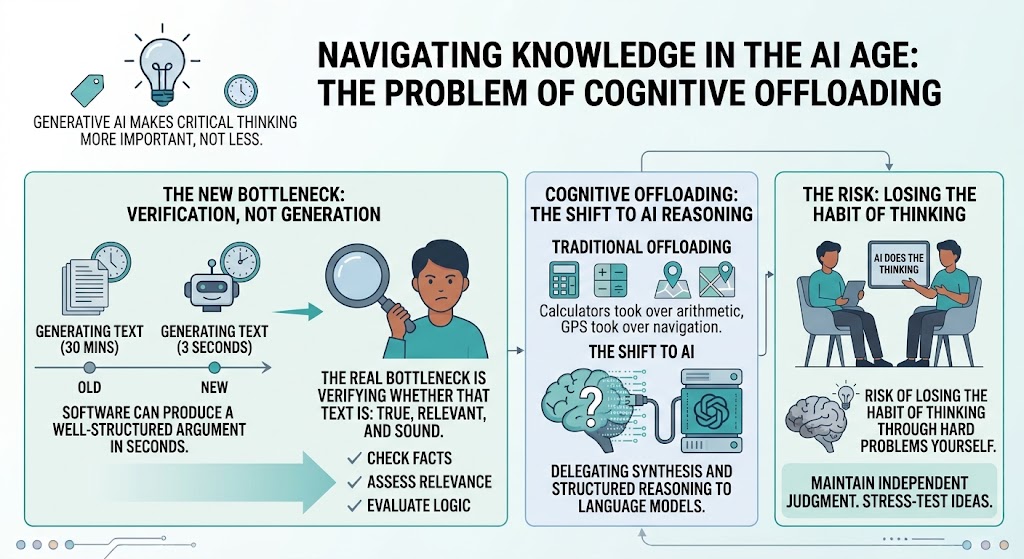
1. The Cost of Cognitive Offloading
Cognitive offloading, or using external tools to reduce mental effort, has been around for centuries. Writing helped with memory, calculators replaced manual arithmetic, and digital maps replaced printed road atlases.
However, as research covered by the American Psychological Association explains, generative AI differs in a fundamental way. It offloads the organization of ideas, the structure of arguments, and creative synthesis itself.
Bypassing the friction of writing, outlining, and editing brings risks. When you skip the work of structuring messy ideas into a clear line of thought, you hand over control of your own reasoning.
The practical response is not to abandon these tools. It is to keep from accepting their answers uncritically. The objective is to stop using AI to decide what to think, and instead use it to test how you think.
2. Plausibility vs. Accuracy
Language models are probabilistic systems designed for coherent syntax, not objective fact. As outlined in UNESCO's Guidance for Generative AI in Education and Research, generative tools build likely sequences of words without any direct comprehension of physical or social reality.
This creates a common trap: superficial plausibility. Because an answer sounds authoritative and well-constructed, people tend to accept it without verification.
Avoiding this error requires a few clear practices:
-
Verify primary sources: Never rely on synthetic citations or summaries for critical claims. Follow assertions back to source papers, raw data, or verifiable documents.
-
Seek disconfirming evidence: Instead of prompting a tool to support an idea, ask it for counterexamples, alternative explanations, and historical cases where the logic failed.
-
Separate noise from bias: Watch for both systemic bias in training datasets and hallucinations caused by leading prompts.
This can be built upon, leveraging the heuristics and tools I lay out in my book, and adapting them for AI.
3. Moving Beyond Basic Prompts
Early discussions about AI often focused on prompt syntax, treating specific phrases as the key to getting good answers on the first try. In practice, effective work looks more like an editorial review.
Experienced operators treat an LLM like a junior researcher. The process moves in stages:
[ Human: Define parameters, context, and core hypothesis ]
                           |
                           v
[ AI: Synthesize research, outline options, identify counterarguments ]
                           |
                           v
[ Human: Fact-check sources, challenge assumptions, evaluate edge cases ]
                           |
                           v
[ Final Decision or Output ]
Instead of asking, "What should my market entry strategy be?", an experienced user provides the ground rules:
"Here is my market entry hypothesis and its core assumptions. Challenge each assumption with historical examples where similar approaches failed."
This keeps the human responsible for judgment while using the model for broad research and stress-testing.
4. The Value of Human Judgment
The professionals who get the most value from language models will not be the people collecting prompt templates. They will be the ones with strong domain knowledge, clear mental models, and the discipline to double-check convenient answers.
Software can produce infinite volume. Critical thinking determines what is worth keeping, what is accurate, and what to ignore.



Related Thoughts
Perspectives sharing related architectures, models, and domain context.
AI and Cognitive Debt
One of the topics I didn't talk about in my book is AI-driven cognitive debt that can weaken existing critical thinking...
Everyone's Thinking Spatially Even If They Don't Call It Geography
Matt Forrest shared a story that struck a chord with me. He talked about winning an atlas in a third grade contest and...
The Illusion of Autonomy: Why AI Breakthroughs Still Require Human Oversight
A fascinating debate recently broke out on LinkedIn that cuts right to the heart of how we evaluate technological...