 September 27, 2026 • 5 min read • Published by David G. Smith
The Mechanics of Attention Loss in Large Language Models: Why AI Forgets What You Just Said
The race to build models with massive context windows has dominated the generative AI landscape over the past year. We moved rapidly from limits of 4,000 tokens to figures exceeding one million. In theory, a one-million-token context window allows a model to ingest entire codebases, multiple novels, or years of financial records in a single prompt. In practice, feeding a massive document into an LLM often results in a subtle but pervasive degradation of performance known as attention loss.
When a model loses attention, it doesn'crash. It simply ignores specific instructions, hallucinates facts that contradict the provided text, or relies heavily on its pre-training weights instead of the in-context data. Understanding why this happens requires looking at the underlying math of the transformer architecture and the physical limitations of memory allocation.
Why Attention Loss Happens
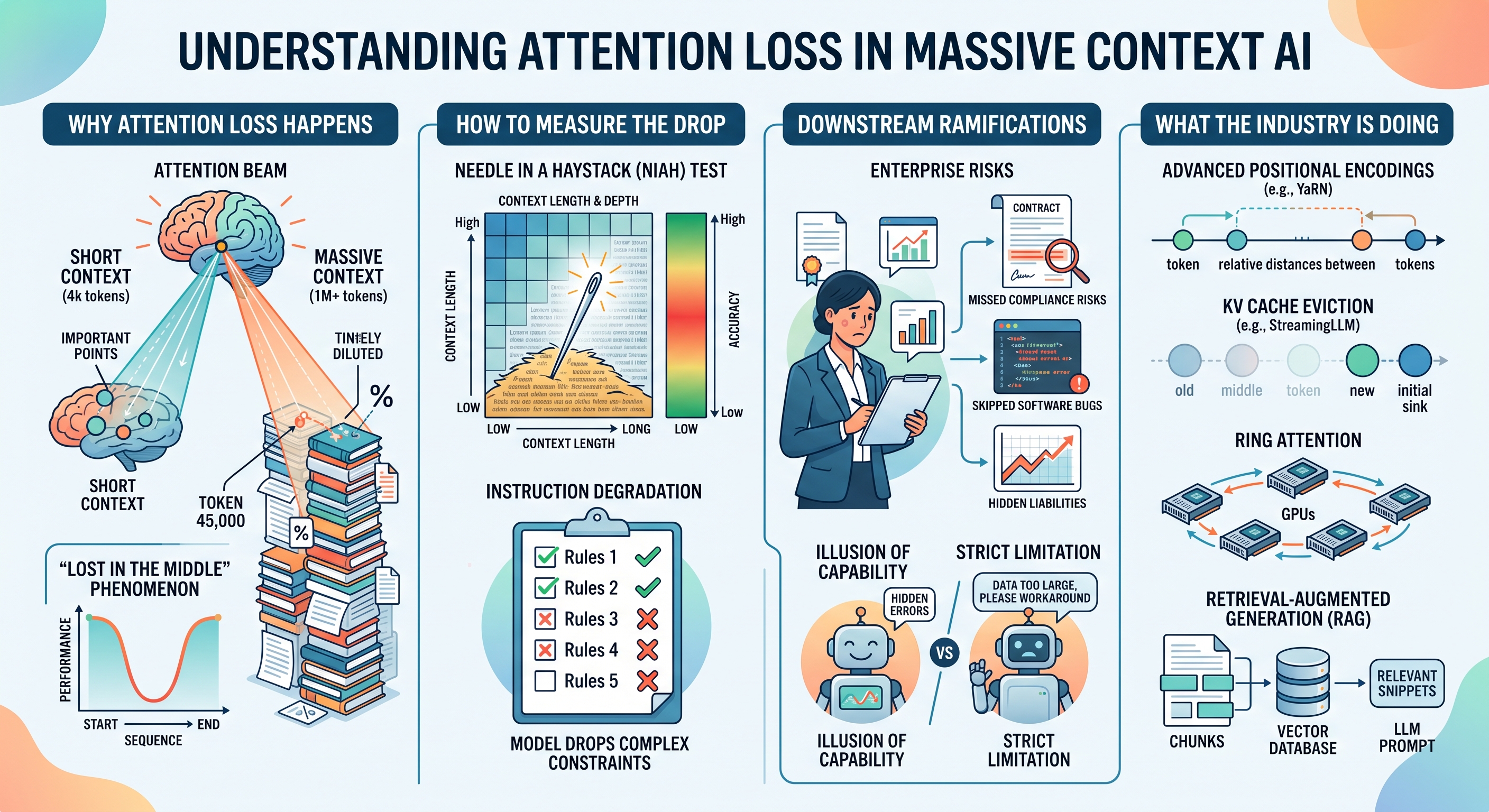
The root cause of context degradation lies in the self-attention mechanism itself. Transformers process text by assigning attention scores between every token and every other token in a sequence. As the sequence grows longer, the model must distribute its attention scores across a vastly larger number of data points.
This creates a dilution effect. If a critical instruction is buried at token 45,000 in a 100,000-token prompt, the raw attention score assigned to that specific instruction becomes mathematically infinitesimal compared to the aggregate attention scores of the surrounding noise. Researchers famously documented this as the "Lost in the Middle" phenomenon, demonstrating that models are highly proficient at retrieving information at the very beginning and very end of a prompt but struggle significantly with information located in the middle.
Hardware constraints also play a major role. To process long sequences without recalculating everything from scratch, models use a Key-Value (KV) cache. The KV cache stores representations of all previous tokens. As the prompt grows, the KV cache scales linearly, consuming massive amounts of GPU VRAM. When models are forced to compress this cache or when rotary position embeddings (RoPE) are stretched beyond their optimal training distribution, the model's spatial awareness of where tokens reside in relation to one another begins to break down.
How to Notice and Measure the Drop
Attention loss is insidious because the model remains fluent. It will confidently generate output that looks correct but misses the core constraints of the prompt. Engineers and researchers use specific frameworks to audit this behavior.
Needle in a Haystack (NIAH) Testing: The most common diagnostic tool is the NIAH evaluation. This involves taking a large block of filler text (the haystack) and inserting a specific, out-of-context fact (the needle) at varying depths. You then prompt the model to retrieve that fact. By plotting the retrieval accuracy on a grid of context length versus insertion depth, you can visualize the exact point where a specific model's attention begins to fail.
Instruction Degradation: Another clear symptom is dropped constraints in complex workflows. If you provide an LLM with a 50-page document and append a five-step formatting rule at the end, a model suffering from attention loss might apply rules one and two but completely ignore rules three through five.
Repetition and Looping: When the KV cache becomes corrupted or overly compressed, models lose track of what they have recently generated. This often results in infinite loops where the model repeats the same paragraph or code block endlessly, unable to attend to the tokens that signal the task is complete.
The Downstream Ramifications
The failure to maintain attention across long contexts creates severe constraints for enterprise AI deployments.
When developers trust a large context window to handle document analysis, attention loss directly translates to missed compliance risks, skipped legal clauses, or ignored software bugs. The illusion of capability is more dangerous than a strict limitation. A model that refuses a 100,000-token prompt forces the developer to find a workaround. A model that accepts the prompt but silently drops 20 percent of the information creates a hidden liability that might not be discovered until the output reaches production.
This unreliability forces teams to build complex, brittle wrappers around their AI agents to double-check their work, eroding the speed and efficiency gains the technology was supposed to provide.
What the Industry is Doing About It
Architectural improvements and novel retrieval methods are actively being deployed to fix the memory bottleneck.
Advanced Positional Encodings: Standard positional encodings struggle when extrapolated to sequence lengths they never saw during training. Techniques like YaRN (Yet another RoPE extensioN) scale the attention mechanism to handle longer contexts without losing the relative distance between tokens, keeping the model anchored even at extreme lengths.
KV Cache Eviction: Rather than storing every single token in the KV cache, researchers are developing methods to identify and keep only the "heavy hitters." Frameworks like StreamingLLM prove that you can maintain high performance by keeping the initial tokens (the attention sink) and the most recent tokens, dropping the middle context entirely for continuous generation tasks.
Ring Attention: To bypass hardware limits, Ring Attention distributes the self-attention calculation across multiple GPUs. This prevents any single chip from running out of memory and allows models to process theoretically infinite context windows by passing the token calculations in a circular network.
Retrieval-Augmented Generation (RAG): The most practical mitigation for developers today is simply avoiding massive context windows altogether. RAG architectures chunk data, store it in a vector database, and only inject the most relevant paragraphs into the prompt at runtime. By keeping the context window small and dense, RAG forces the model to focus entirely on high-signal information, sidestepping the attention dilution problem completely.



Related Thoughts
Perspectives sharing related architectures, models, and domain context.
Building GeoAI Systems That People Can Trust
The latest edition of the GeoAI and the Law Newsletter lays out a clear message for anyone working at the intersection...
The Illusion of Autonomy: Why AI Breakthroughs Still Require Human Oversight
A fascinating debate recently broke out on LinkedIn that cuts right to the heart of how we evaluate technological...
Everyone's Thinking Spatially Even If They Don't Call It Geography
Matt Forrest shared a story that struck a chord with me. He talked about winning an atlas in a third grade contest and...