 October 08, 2026 • 3 min read • Published by David G. Smith
When a Database Stops Being About Data
The DuckDB team recently highlighted a post by Nikolas Göbel on DuckDB, and it’s one of those ideas that sticks because it quietly rewrites how we think about data systems. For years, databases were the place where data lived. They were the center of gravity. That’s not how analytical work happens anymore. Data sits in cloud buckets, object stores, and distributed filesystems. The database has started to become something else. DuckDB’s own write‑up on Göbel’s article is here.
Göbel’s example is straightforward. Picture a robotaxi company with daily Parquet files piling up in blob storage. An analyst wants to explore patterns in high‑fare, short‑distance rides. You don’t want to ship gigabytes of files, and you don’t want to stand up a full warehouse just to give them a clean view. So you create a tiny DuckDB file that holds nothing but instructions. It’s a map, not a container. The analyst attaches to it and starts querying as if the data were local. Only the columns they need are fetched. Filters cut down the transfer even more. The whole thing feels like opening a hyperlink.
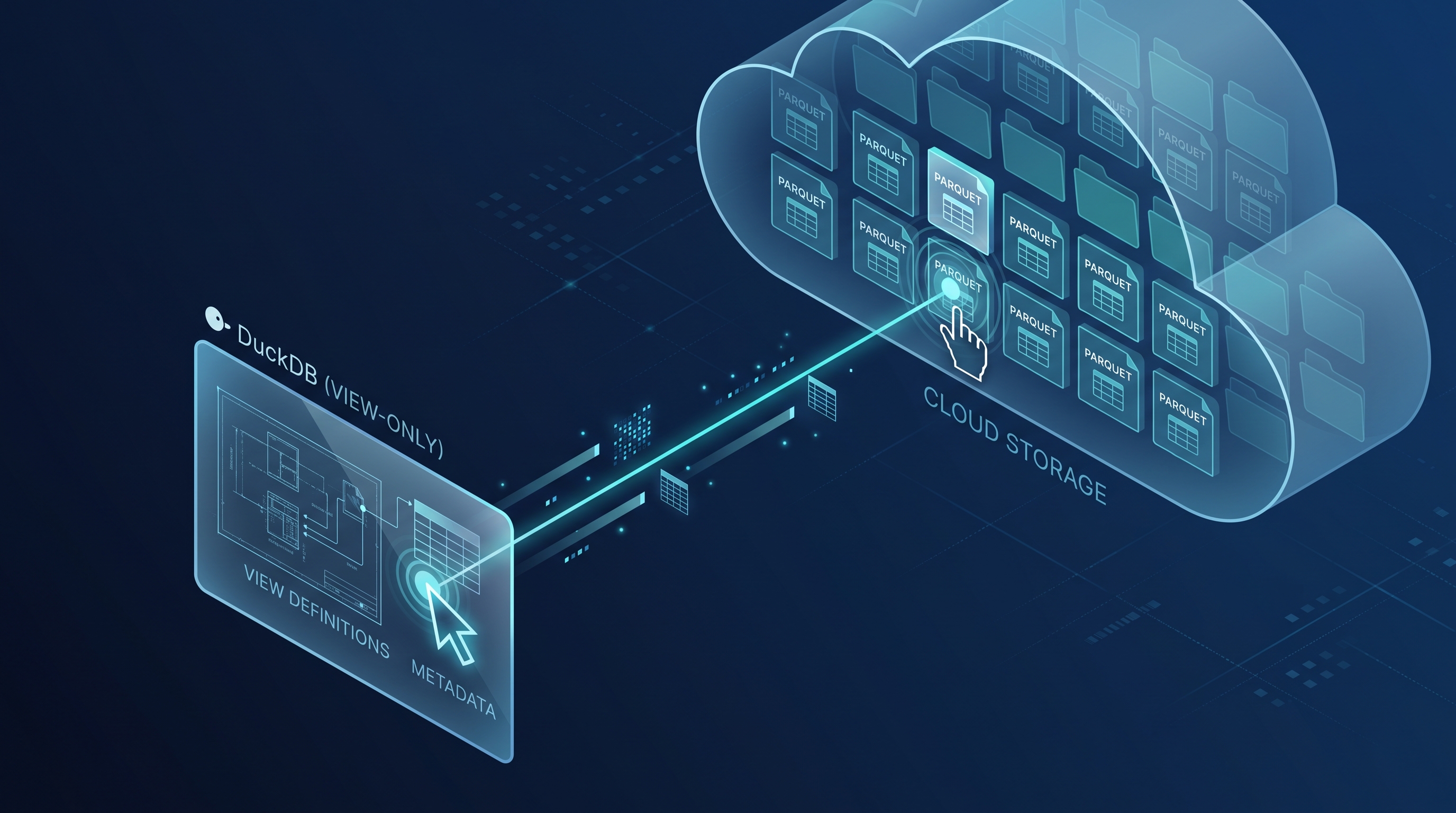
This framing treats relational datasets the same way we treat documents on the web. A database file becomes a pointer to structure, not storage. It’s a description of how to see the world, not a place where the world is kept.
This shift changes how teams collaborate. Instead of sending raw files or building a full warehouse, you share a view. You share intent. You share the logic that defines what’s interesting. The analyst doesn’t have to care about partitioning strategies, schema drift, or how many buckets the data sits in. They just attach and start thinking.
It also hints at a future where analytical systems behave more like browsers. You don’t download the whole dataset. You fetch only what you need. You navigate through structure. You treat cloud storage as the default substrate and the database as the lens that makes sense of it.
For agencies and organizations with sprawling datasets, this is a big deal. We’ve spent years wrestling with the tension between centralizing data for analysis and keeping it distributed for operational reasons. Tools like DuckDB soften that tension. They let you keep data where it already lives while still giving analysts a coherent way to explore it.
There’s a deeper lesson here. We often assume that solving data problems means building bigger platforms, pipelines, and warehouses. Göbel’s example shows that sometimes the right move is the opposite. Sometimes you get more leverage by making the database smaller. Sometimes the most powerful thing you can share isn’t the data itself, but the way you’ve chosen to look at it.
The tools we use shape how we see problems. When a database becomes a hyperlink, it encourages a different mindset. You stop thinking about storage and start thinking about structure. You stop worrying about where the data sits and start focusing on what questions you want to ask.
That’s a healthier way to work. It’s also a reminder that good thinking often starts with good framing. DuckDB’s view‑only model is a technical feature, but it’s also a nudge toward a more flexible way of understanding data. And that’s worth paying attention to.



Related Thoughts
Perspectives sharing related architectures, models, and domain context.
LLMs Aren't Reasoning. They're Predicting - And Why That Matters More Than People Think.
Thore Graepel just published a piece in MIT Technology Review that deserves attention. His argument is simple: Modern...
AI Can Now P‑Hack at Scale. The Real Risk Isn't Cheating. It's Obedience.
For years, p‑hacking was a slow, human problem. A researcher could sift through enough models and enough specifications...
The Shift to Cloud-Native Geospatial: Access, Scale, and the Open Source Ecosystem
Traditional GIS architectures were built around assumptions that no longer hold: you download data to your local...