 October 04, 2026 • 3 min read • Published by David G. Smith
Why Vector Search Breaks Down When You Need Real Reasoning
There is a growing realization in the AI engineering world that vector search is hitting a ceiling. It still works well for fuzzy matching and broad semantic retrieval, but it struggles when the task requires actual reasoning. The article “Why Vector Search Fails at Multi-Hop Reasoning” by Agwu Eze makes this point clearly and shows why GraphRAG is becoming the next serious step for enterprise AI.
The core argument is simple. Vector search treats text as isolated chunks. It doesn't understand relationships. It doesn't understand structure. It doesn't understand how facts connect across pages, documents, or regulatory frameworks. When you ask a question that requires multi-hop inference, vector search often retrieves the wrong pieces or misses critical links entirely. The result is a system that looks intelligent on the surface but fails when the stakes are high.
The article uses a real example from the African Continental Free Trade Area. To answer a question about exporting processed cocoa powder from Ghana to Nigeria, an AI system must connect facts scattered across pages about HS codes, certificates of origin, NAFDAC requirements, and transit protocols. Vector search can retrieve some of these pieces, but it was found that it couldn't reliably assemble the chain of reasoning. It couldn't fully understand the topology.
This is where GraphRAG enters the picture. Instead of relying on similarity scores, GraphRAG builds a labeled property graph that captures entities and relationships. The system extracts triples from documents, stores them in Neo4j, and uses deterministic graph traversal to retrieve the relevant subgraph. The LLM is then grounded strictly in those facts. If the graph does not contain the answer, the model says so. No guessing. No hallucination.
The architecture described in the article is worth paying attention to. It combines sliding window chunking, triple extraction with Gemini, Neo4j Aura Cloud, two-hop Cypher traversal, PyVis visualization, and strict grounding rules. The result is an auditable reasoning engine that produces verifiable reports. Every answer has a traceable lineage. Every relationship is visible. Every inference is grounded in the graph.
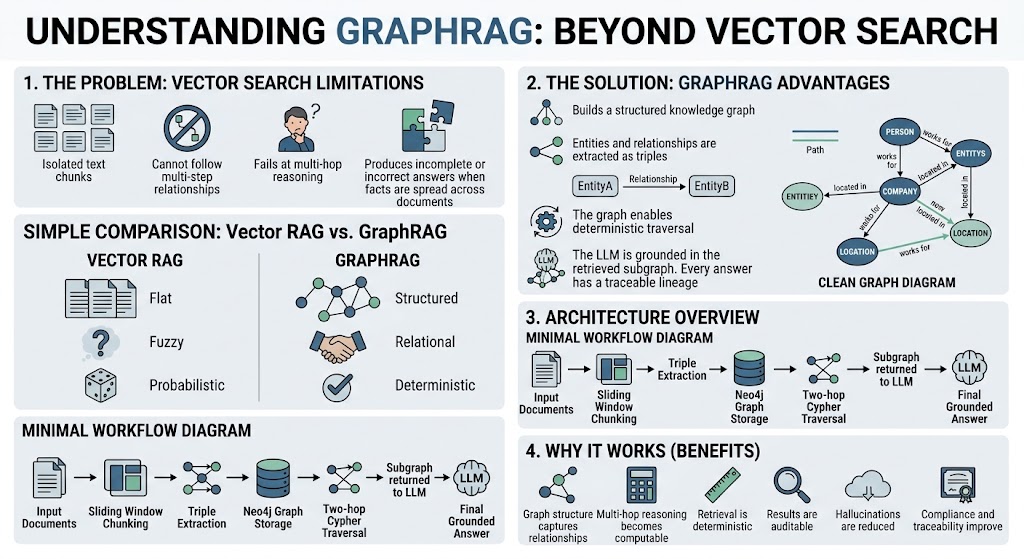
This is the direction enterprise AI is moving. Not toward bigger embeddings or more clever chunking strategies, but toward systems that combine structured knowledge with generative reasoning. The article’s comparison table makes the point clearly. Vector RAG is flat and probabilistic. GraphRAG is relational and deterministic. Vector RAG guesses. GraphRAG proves.
There are several implications worth exploring:
First, this approach aligns with the broader shift toward agentic systems. Agents need reliable memory and reliable reasoning. They can't operate on fuzzy similarity alone. A graph-backed memory layer gives agents a way to navigate knowledge with precision.
Second, this model fits naturally with cloud-native geospatial workflows. Many geospatial problems are inherently multi-hop. Supply chains, transit corridors, environmental dependencies, and regulatory overlays all form networks. A graph-first approach makes these relationships explicit and computable.
Third, this architecture supports compliance-heavy domains. When an AI system must justify its answer, a graph with an audit trail is far more defensible than a vector database with opaque similarity scores.
Fourth, this approach opens the door to hybrid reasoning systems. A graph can store structured facts. An LLM can interpret them. A geospatial engine can add spatial constraints. A policy engine can enforce rules. Together they can form a composite intelligence that is more reliable than any single component.
The article is a strong signal that the industry is moving beyond naive RAG. The next wave of AI systems will be built on topological reasoning, structured knowledge, and verifiable inference. Vector search will still have its place, but it will no longer be the backbone of enterprise AI.
If you are building systems that need to reason across documents, regulations, spatial networks, or multi-step workflows, this is the architecture to watch.



Related Thoughts
Perspectives sharing related architectures, models, and domain context.
The Illusion of Autonomy: Why AI Breakthroughs Still Require Human Oversight
A fascinating debate recently broke out on LinkedIn that cuts right to the heart of how we evaluate technological...
Building GeoAI Systems That People Can Trust
The latest edition of the GeoAI and the Law Newsletter lays out a clear message for anyone working at the intersection...
Demystifying GraphRAG: How You Can Learn And Get Up And Running For Free
GraphRAG (Graph Retrieval-Augmented Generation) is quickly becoming a critical architecture for building reliable AI...