 September 18, 2026 • 3 min read • Published by David G. Smith
Demystifying GraphRAG: How You Can Learn And Get Up And Running For Free
GraphRAG (Graph Retrieval-Augmented Generation) is quickly becoming a critical architecture for building reliable AI applications. While standard RAG relies entirely on searching through isolated text chunks, GraphRAG maps your data into a network of interconnected points (referred to as nodes and edges). This subtle change completely reshapes how a Large Language Model (LLM) understands your data.
If you have been putting off learning it because graph databases sound intimidating, the barrier to entry is actually incredibly low. By using free resources like self-paced tutorials on Neo4j GraphAcademy and a cloud-hosted Neo4j Aura free-tier account, you can build a working prototype in a single afternoon.
The Real-World Utility of GraphRAG
To understand why this architecture is gaining traction, look at how traditional vector search handles complex data compared to GraphRAG.
Imagine you are building an AI assistant to analyze hundreds of corporate legal contracts and vendor agreements.
- The Traditional RAG Approach: A user asks, "Are there any systemic compliance risks across our manufacturing vendors?" A standard vector database searches for the text chunk that sounds closest to "compliance risks." It might pull a paragraph from Contract A and a paragraph from Contract B, but it cannot naturally connect the dots between them.
- The GraphRAG Approach: GraphRAG treats vendors, contracts, clauses, and regulations as interconnected points (nodes) and lines (relationships). The system can trace a path like:
[Vendor A] -> signs -> [Contract B] -> references -> [Regulation C].
Because the data structure inherently understands connections, the LLM can easily perform "multi-hop" reasoning. It can instantly see that five different vendors are all bound to an outdated version of a specific regulation, allowing it to synthesize a comprehensive, global answer that traditional semantic search would completely miss.
Traditional RAG vs. GraphRAG at a Glance
| Feature | Traditional RAG | GraphRAG |
|---|---|---|
| Data Organization | Isolated text chunks and vectors | Interconnected concepts, entities, and relationships |
| Search Mechanism | Flat semantic similarity | Similarity combined with relationship tracing |
| Contextual Depth | Limited to immediate text fragments | High (captures the broader network of information) |
| Complex Queries | Struggles with cross-document summarization | Excels at global, multi-document synthesis |
A Frictionless, Cost-Free Way to Learn
You don’t need an enterprise infrastructure budget or a background in advanced data structures to experiment with this. The existing developer ecosystem makes it highly accessible:
1. Hands-on Learning via GraphAcademy
Instead of wading through dense documentation, Neo4j’s GraphAcademy offers entirely free, self-paced courses. They feature dedicated developer paths for LLMs and AI integration, providing interactive environments where you write code directly in the browser to see how graphs feed context into LLMs.
2. Sandbox Environments with Neo4J Aura Free Tier
You don't need to go through the hassle of installing databases locally or configuring Docker containers. Neo4j Aura provides a completely free cloud instance that spins up in minutes. It gives you a fully functional sandbox to load your data, run vector searches, and test your RAG pipelines without having to build infrastructure or pull out a credit card.
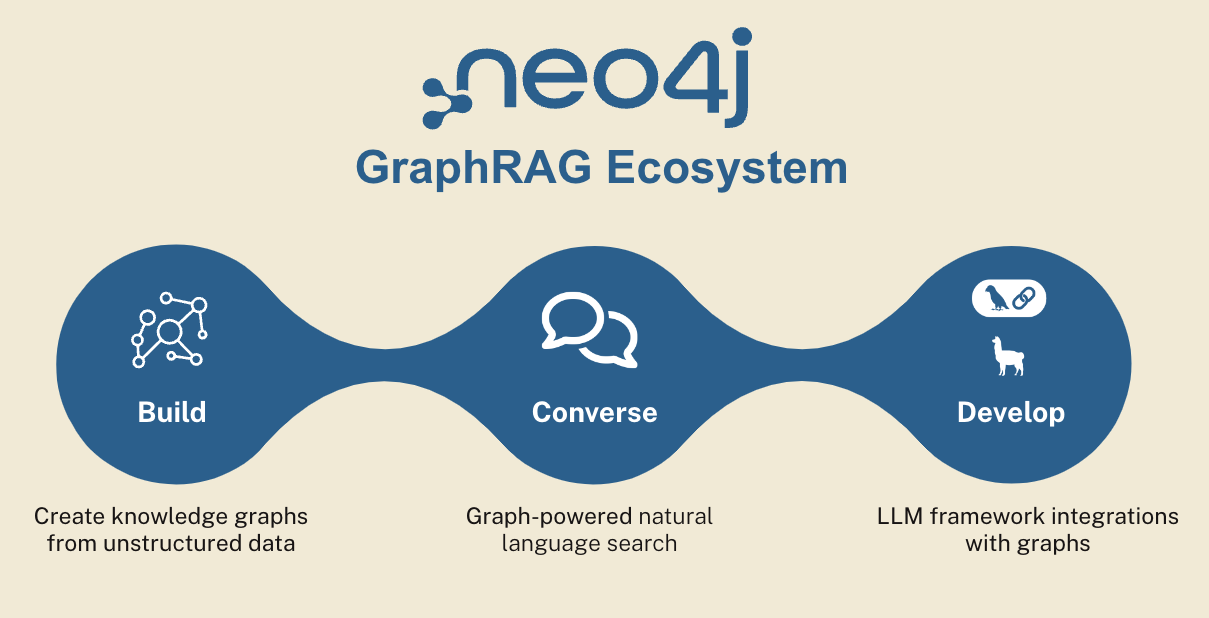
3. Open Framework Integration
GraphRAG isn't a walled garden. A free graph instance hooks directly into the tools developers already use daily, including LangChain, LlamaIndex, and standard Python AI libraries.
How to Start Experimenting
If you want to move past basic semantic search and build AI tools capable of exploring complex connections, the tools are readily available. You can get a baseline prototype running today by signing up for a free sandbox on Neo4j Aura, looking over the foundational LLM courses on GraphAcademy, and connecting them to your favorite AI orchestration framework.



Related Thoughts
Perspectives sharing related architectures, models, and domain context.
America.gov, APIs, and the Future of Public Information
The recent conversation around America.gov highlights something that has been building for years. Something I've been...
The Illusion of Autonomy: Why AI Breakthroughs Still Require Human Oversight
A fascinating debate recently broke out on LinkedIn that cuts right to the heart of how we evaluate technological...
The Convergence of Spatial SQL and Ontologies: Building a Semantic Backbone for Earth Observation
The geospatial industry is undergoing a quiet but profound shift. For decades, the standard workflow for analyzing...